Every week somebody calls our office with the same story. They shipped a pallet to a customer — a storefront, a clinic, somebody’s garage — and the freight bill came back heavier than the quote. Buried in the charges: a liftgate fee. Sometimes a delivery got refused entirely because the truck showed up with no liftgate at all, and the receiver had no forklift. Now the freight’s riding back to a terminal and everyone’s mad.
After 40+ years of running freight around Atlanta, I can tell you: liftgate charges are one of the most common ways a freight bill balloons past the quote. Here’s how it actually works, what it costs, and how to keep it from biting you.
First — What a Liftgate Is and When You Need One
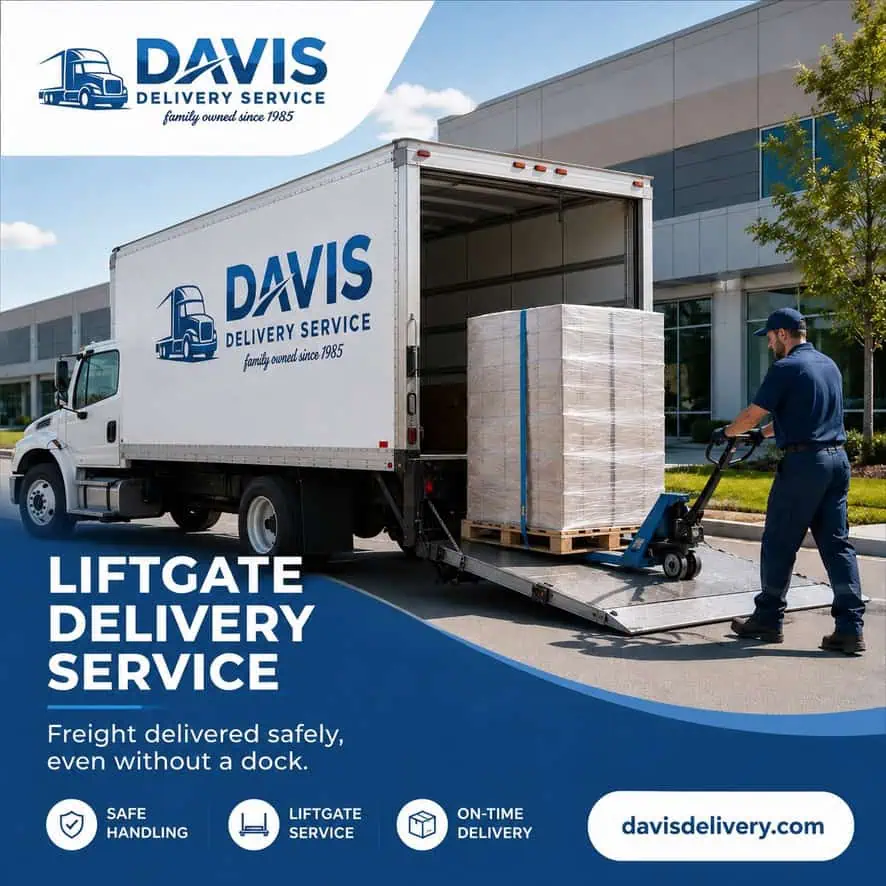
A liftgate is the hydraulic platform on the back of a truck that lowers freight from trailer height down to the ground. Simple piece of equipment, but it’s the difference between a clean delivery and a problem, because a pallet weighing 800 pounds doesn’t come off a truck by hand. If you want the fuller picture, here’s what a liftgate is and how it works.
You need one any time the delivery location doesn’t have a loading dock or a forklift. Around Atlanta, that’s more places than people think: retail storefronts, medical and dental offices, job sites, schools and churches, homes, and plenty of smaller warehouses and shops. If you’re not sure whether your receiver has a dock — ask. It’s the single most useful question in freight.
What the Big Carriers Charge for It
With most national LTL carriers, a liftgate is what the industry calls an accessorial — an add-on service billed on top of your base rate. Depending on the carrier and the tariff, the published minimum runs anywhere from $75 up to $235 per stop, and the charge climbs by weight from there. And accessorials stack: liftgate plus residential delivery plus limited-access location.
The part that stings worse than the fee is when it’s discovered late. If nobody flagged the liftgate up front, the carrier either bills it after the fact — that’s the surprise on your invoice — or the driver arrives without the equipment and the delivery fails. A redelivery fee usually follows. Your customer waits another day or two. Nobody wins.
How We Do It Differently
I’ll be straight about where we stand: at Davis Delivery, every straight truck in our fleet has a liftgate, and we charge a flat $50 to use it. Not $75 one day and $235 the next, and not a surprise on the back end — a flat fifty, quoted before the truck rolls, with a driver trained to run the gate. For the kind of Atlanta freight we handle every day — tile and flooring to job sites, equipment to storefronts, pallets to businesses without docks — that’s often less than half of what a national carrier’s liftgate fee runs, and you always know the number up front.
That predictability is a real difference on the total cost of a shipment, and it’s why a lot of flooring distributors and suppliers around metro Atlanta run their final mile through us instead of a national network.
How to Avoid Liftgate Surprises on Any Carrier
- Ask the receiver about their dock before you book. Thirty seconds on the phone saves a failed delivery.
- Flag the liftgate when you get the quote, not after. A fee you know about is a cost; a fee you didn’t is a problem.
- Watch for stacking accessorials. Residential, limited access, appointment required — ask for the all-in number.
- For regular no-dock deliveries, use a carrier with a flat, up-front liftgate rate. If half your freight ends at storefronts and job sites, unpredictable per-stop fees add up fast.
The Bottom Line
Liftgate delivery in Atlanta costs whatever your carrier’s tariff says it costs — a published minimum of $75 to $235 a stop on a national carrier, billed by weight above that, and frequently as a surprise you didn’t see coming. Ours is a flat $50, quoted before the truck leaves the yard, because the gate’s already on every box truck. Either way, the expensive version is the one nobody planned for. And if you’re still working out whether your delivery needs a gate in the first place, start with what a liftgate actually is.
Got freight going somewhere without a dock? Request a quote or call us at (678) 926-3939 — Monday through Friday, 6 AM to 6 PM. A real person answers, and they’ve loaded a truck before.