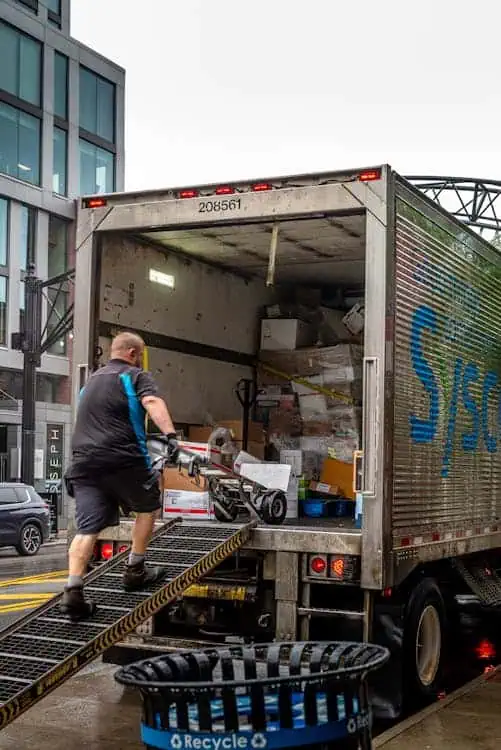
Most of what gets written about liftgate delivery stops at the moment the fee gets quoted. You learn the receiver has no dock, you add the liftgate, you pay for it, and the assumption is that everything after that takes care of itself.
Usually it does. But when a liftgate delivery falls apart, it almost never falls apart because of the liftgate. It falls apart because of something at the receiving address that nobody looked at before the truck was dispatched. Gravel. A curb. A crate a few inches too wide for the platform. Nobody on site with a key.
If you are still working out whether your freight needs a gate at all, start with what a liftgate is and how it works. This page is about the part that comes after that decision — what has to be true at the delivery address for the gate to actually do its job.
Booking the Gate Is Only Half of It
A liftgate solves exactly one problem. It moves freight from the height of a truck floor down to the height of the pavement. That is the entire job. Everything that happens after the platform touches the ground is a pallet jack, a driver, and whatever surface your receiver happens to have.
That second half is where deliveries die. And when they die there, the carrier still counts it as an attempt. You get the redelivery charge, your customer waits another day or two, and the paperwork says the liftgate was provided as ordered — which it was.
The Surface Under the Freight
A pallet jack has small, hard wheels and no power. It needs a hard, flat, continuous surface between wherever the truck can park and wherever the freight is going. That is a narrower requirement than it sounds.
Gravel stops a loaded pallet jack cold. So does grass, packed dirt, fresh mulch, and the soft edge of an asphalt lot in August. The wheels sink, the pallet quits moving, and there is no version of that where one driver muscles it the rest of the way.
Slope is the other one. A loaded pallet on a grade wants to go downhill, and a pallet jack has no brake. A driver who tells you he is not taking a pallet down a sloped driveway is not being difficult. He is being right.
Then there is the curb. The platform comes down to whatever the truck is parked on, which is normally the street or the lot. If a six-inch curb sits between that spot and the door, a pallet jack cannot climb it. You need a curb cut, a driveway apron, or somewhere flush the truck can pull to. This is the one that catches people at strip centers and older storefronts, whether the address is out on Buford Highway or a clinic parking lot in Gwinnett County.
Where the Freight Actually Gets Set Down
Liftgate delivery means the freight comes off the truck and onto the ground at the nearest practical spot. It does not mean the freight goes inside. Once a pallet crosses the threshold of a building, that is inside delivery, and on most carriers it is a separate service with its own charge.
This is the most common argument at the back of a truck, and it is almost always a communication problem rather than a service problem. The shipper booked liftgate. The receiver heard “they are bringing it in.” Nobody told the driver anything at all. Say out loud, to the person receiving it, where the pallet is going to end up. Two sentences on the phone prevents the entire thing.
Pallet Size, Shape, and Stability
A liftgate platform is sized for pallets. A standard 48-by-40 pallet sits on one comfortably. A long crate, a wide piece of machinery, or an odd-shaped skid can hang over the edges, and overhang becomes a problem well before weight does — the load has to sit stable while the platform is moving.
Tall and top-heavy is the same story. The platform tilts as it travels, and a load stacked high out of loose cartons with a couple of turns of shrink wrap will shift. Band it, corner-board it, or build it shorter. Rated capacity is a separate question, and how much weight a liftgate can handle is covered elsewhere — but plenty of shipments sitting well under the rating still cannot ride a gate because of how they were built.
Somebody Has to Be There
Receiving hours are not the same thing as posted business hours. A shop that unlocks at nine may not have anybody who can sign until ten. A one-person business closes when that person goes to lunch or leaves for a job. Churches, schools and clinics all keep their own windows, and none of them are the window painted on the front door.
If the receiver needs a call ahead or a set appointment, book it. Most carriers charge something for notification or an appointment, and it is a small number sitting next to a redelivery fee and a second lost day.
One more thing while somebody is standing there. Look at the freight before signing. If a carton is crushed or a pallet is leaning, write it on the delivery receipt. A receipt signed clean makes a damage claim very hard to win afterward, and the driver is not the one who decides that.
What to Put on the Bill of Lading
The driver never sees your email to the sales rep. He sees the bill of lading and whatever dispatch typed into the stop. So the BOL is where this information has to live.
Write “liftgate required at delivery” in the accessorial or special instructions field, not in a note somewhere off to the side. Put a receiver contact name and a mobile number a person actually answers — a main line that rolls to voicemail is the same as no number. Flag residential or limited access yourself if that is what the address is, because the carrier will find out and bill it either way, and finding out at the curb is how attempts turn into failures. If the freight is oversized, put the real dimensions on the paperwork. And if the delivery point is gravel, unpaved, or has no curb cut, say that too. A dispatcher who knows in advance can send the right truck or call you before it rolls. A dispatcher who hears it from a driver already standing in a gravel lot cannot do anything with it.
The Five-Minute Call
Before you book anything, call the person receiving the freight and ask five things. Do you have a dock or a forklift? Where can a straight truck park, and is there room behind it to set a platform down? Is the path from there to where this is going hard, flat, and clear of curbs and slope? Who signs for it, and what hours are they honestly there? And is there anything else about the address a driver would want to know — a gate code, a back entrance, a lot a big truck cannot turn around in?
Five questions. It takes less time than filing a claim, and it is the difference between a delivery that happens and one that has to be made twice.
At Davis Delivery, every box truck in our fleet is liftgate-equipped, along with some of our 53-foot trailers and our 32-foot pup trailers, and liftgate service is a flat $50 per delivery where most national carriers bill it as an accessorial with a published minimum of $75 to $235 that then climbs with the weight of the freight. That is the pricing side, and there is a full Atlanta cost breakdown if that is what you came for. The operational side is the part that decides whether the delivery works at all, and it is why our dispatchers ask about surfaces and curbs before a truck leaves the yard in Buford. Our drivers run gates every day rather than a few times a month. That is how we handle liftgate delivery across metro Atlanta, including same-day deliveries across Georgia.
Tell us about the delivery site and we will tell you what the truck needs — call Davis Delivery at 678-926-3939, Monday through Friday, 6 AM to 6 PM. We run out of Buford, off Exit 8 on I-985.
Ready to ship with Georgia’s most reliable LTL carrier? Request a free quote from Davis Delivery Service today, or call us at 678-926-3939.